


There’s a very specific kind of exhaustion that comes from being “nice.”
Not the obvious kind. Not the I worked too much or I didn’t sleep enough tired. I mean the exhaustion that comes from constantly tracking other people — what they might be feeling, what they might need, how to make things smoother so no one is uncomfortable. The kind where you’re tired before anything has even happened.
I learned this early, mostly by watching my mom.

She did everything herself. Always. If something needed to be handled, she handled it. If someone was stressed, she absorbed it. If help was needed, she didn’t ask — she just quietly did more. And when someone thanked her, she waved it away with, “You don’t need to thank me,” or “That’s what I’m here for.”
Care wasn’t something she did.
It was something she was.
A role. An expectation. A full time job that somehow never came with an off switch or much recognition - and it scared the crap out of me.
Watching her, I learned something: that love can mean self-erasure. That competence is carrying everything yourself. That needing less is a kind of moral achievement.
Even before I had the language to articulate it, the role of “mother” felt deeply unappealing to me. From my perspective, it looked like a position defined by endless responsibility, and I wanted no part in it. What I didn’t realize at the time was that I had already begun internalizing many of those same behaviors. Long before motherhood was even relevant to my life, I was absorbing patterns that had been modeled for me. Patterns that had likely been passed down from my grandmother to my mother as well.
Growing up around that, I didn’t learn to ask, Is this my responsibility?
I learned to ask, Why wouldn’t I handle it?
So I became the reliable one. The low-maintenance one. (Low maintenance, I learned early, is supposed to be a compliment.) I say yes easily. I don’t want to be a burden. I anticipate needs before they’re spoken. I step in before anyone has to ask.
And when I don’t, I feel a quiet, creeping discomfort. Like I’m letting something slide.
For a long time, I thought this was just who I was. Thoughtful. Attuned. Good with people.
But eventually I started losing myself.
I was hyper fixated on pleasing those around me. Whenever I ruminated on stressful interpersonal interactions, I never considered my own feelings. I was mapping the other person’s emotions. Explaining their reactions. Justifying their behavior. Figuring out how to make it better for them.
In practice it can look like this:
You and your partner had tension building for weeks. Before bringing up something that bothered you, you rehearsed it alone:
If I say I felt hurt, they’ll think I’m accusing them.
They’ve been overwhelmed with work.
They had a rough childhood; conflict makes them shut down.
Maybe I’m just being too sensitive.
By the time you actually spoke, the sentence had softened into something almost unrecognizable: “It’s really not a big deal, and I totally get why you reacted that way, I just maybe felt a little weird about it?”
You had already argued their case for them.
Instead of asking, Why did that hurt me? you asked, How do I say this so they don’t feel bad?
On a day to day basis I could tell you exactly why someone acted the way they did — and almost nothing about what I needed in response.
Somewhere along the way, I stopped asking myself that question entirely:
What does Ananya need?
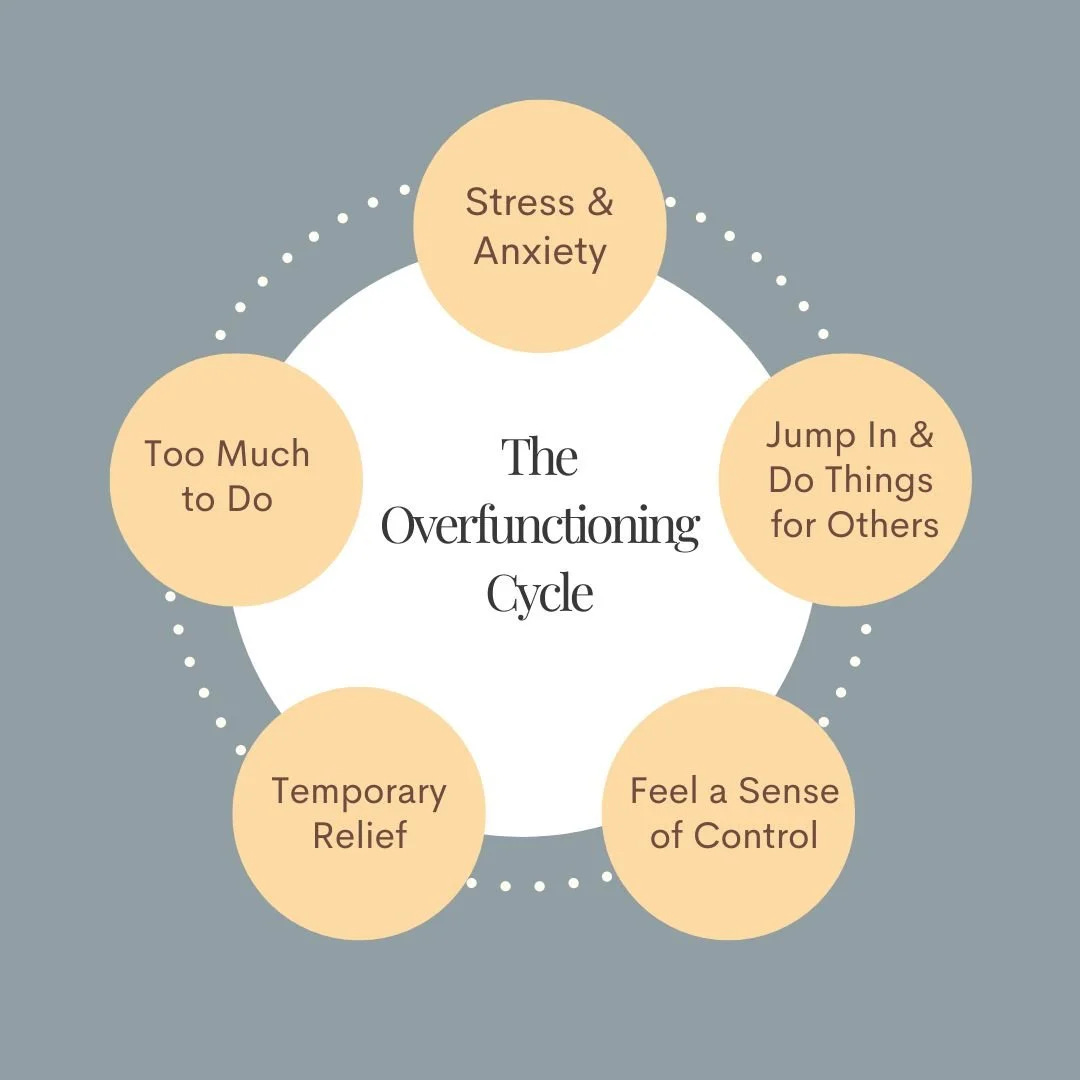
Overfunctioning
Researchers call it overfunctioning. In Gen Z terms, maybe it’s just “doing too much.” But overfunctioning doesn’t announce itself. It doesn’t feel dramatic or unhealthy at first. It feels like being kind. Being competent. Being the kind of woman who doesn’t make things harder for others.
In Bowen Family Systems Theory, overfunctioning–underfunctioning reciprocity refers to a patterned relational response in which one partner consistently takes on greater responsibility for managing emotions and decisions while the other becomes relatively less responsible, often in response to anxiety within the relationship (Kerr & Bowen, 1988).
In practice, this dynamic unfolds quietly through everyday decisions and emotional labor. As a previous overfunctioning partner: I anticipated needs, managed logistics, de-escalated conflict, and monitored the emotional climate of the relationship. I was anxious about losing my partner. And because that system became stabilized by my effort, my ex partner gradually stepped back from relational responsibilities they might have otherwise carried.
Over time, the person who once stepped in to help now feels implicitly responsible for maintaining the relationship’s equilibrium.
In families, this pattern often converges with broader cultural expectations that position women—especially mothers—as primary managers of both emotional and organizational labor. The result is a chronic mental load: constant monitoring, anticipating, and adjusting to prevent disruption. Sustaining that level of vigilance requires ongoing cognitive and emotional effort, which helps explain why persistent overfunctioning so often culminates in exhaustion and burnout.
Burnout
Psychology gives us language for why this kind of care is so exhausting.
Burnout, as described by Christina Maslach and Michael Leiter, isn’t just about long hours or heavy workloads. It’s about chronic emotional exhaustion, especially when someone feels responsible for outcomes they don’t fully control (Maslach & Leiter, 2016). In my experience, burnout felt like trying to keep my hands in as many metaphorical buckets as possible. It was a nightmare where I was the center of a web, trying desperately to keep every thread from snapping.
What made it so consuming was not the amount of work I was doing, but the amount of monitoring I felt responsible for. I was constantly checking in on people, scanning conversations for tension, running relational scenarios in my head. If someone said something that sounded slightly off, I would replay it. If two people were in conflict, I would mentally rehearse what I could say to smooth things over. The mental noise was constant. At times it became so loud that I struggled to concentrate on anything else.
Eventually, exhaustion started to show up in ways I didn’t immediately recognize as burnout. I stopped responding to people. I began to tell myself that I was simply “bad at texting back,” as if it were a personality trait. But that wasn’t actually true. The reality was that I had been carrying emotional responsibility for so long that even small interactions began to feel overwhelming. A simple message could turn into a potential problem to solve, a misunderstanding to prevent, or a conflict to manage.
Avoiding messages was not laziness. It was fatigue.
When the smallest disagreement feels like something you must resolve, every conversation becomes a potential demand on your emotional bandwidth. Eventually the system shuts down.
The emotional effects surprised me most. I became irritable. I withdrew. At times I felt like I simply didn’t care about anyone anymore. That version of myself felt foreign. I have always been someone who values connection deeply, yet burnout left me feeling detached and numb. It wasn’t that I had suddenly become selfish or indifferent. I had just reached a point where I had nothing left to give.
One of the strongest predictors of burnout isn’t simply effort. It’s role overload — a condition in which the demands placed on a person exceed the time, energy, or emotional capacity available to meet them (Bakker & Demerouti, 2007) And a “role” doesn’t only mean a formal position or job description. It can also be a psychologically constructed identity (the mediator, the emotional translator, the steady one, the person who anticipates tension and diffuses it before it erupts, etc.). Often, no one explicitly assigns this role. The individual adopts it internally, sometimes out of care, sometimes out of fear, sometimes out of habit.
Burnout becomes especially likely when this self-appointed role is morally charged (“It’s my job to keep everyone okay”), loosely defined (there’s no clear standard for when you’ve done enough), and never-ending. When responsibility has no boundary, exhaustion has no natural stopping point.
Women as Caregivers
This matters because women are disproportionately placed into these roles, socially and internally.
Arlie Hochschild (1983) famously described emotional labor as the work of managing feelings, both your own and others’, to maintain social harmony. While her original work focused on paid labor, decades of research have shown that women perform a disproportionate share of emotional labor in families and intimate relationships. For example, sociologist Rebecca Erickson (2005) found that women not only do more emotional work in heterosexual partnerships but also feel more responsibility for the emotional climate of the relationship.
I’ve watched that dynamic unfold in real time. After a tense conversation with someone I cared about, I could feel my own hurt rising — a tightness in my throat, the impulse to say, “That didn’t sit right with me.” But almost immediately, my attention shifted outward. Their silence became the problem to solve. I started scanning for cues: Were they overwhelmed? Did I phrase something too harshly? Would bringing up my feelings make them retreat further?
By the time I spoke, the original emotion had already been edited down. “It’s okay, I get why you reacted that way,” I heard myself say, even though I hadn’t actually decided it was okay. The conversation moved on. The tension diffused. My feeling remained, but it no longer had a place in the room.
When care is expected, it shifts from generosity to obligation.
This is one reason so many women report burnout even when they’re not technically “overworked.” The exhaustion isn’t just physical. It’s moral. It comes from carrying a constant sense of responsibility — for how things feel, how things turn out, whether everyone is okay.
For me, this bled into something even deeper: my fear around motherhood.
When I imagine becoming a mother, what scares me isn’t the labor or the logistics.
It’s the loss of identity.
The fear that I wouldn’t be Ananya anymore. I’d just be “mom.” A role that swallows the person inside it. A version of myself defined entirely by care, availability, and sacrifice.
That fear didn’t come from nowhere. It came from watching women, especially mothers, become indispensable and invisible at the same time.
Psychologically, this makes sense. Women are often socialized to link goodness with self-sacrifice. Over time, care stops being something you offer and becomes something you’re expected to be. And once care becomes an identity rather than a choice, stepping back doesn’t feel neutral.
It feels wrong.
This is where burnout starts being about morality.
A lot of women don’t burn out because they don’t know how to set boundaries. They burn out because they feel morally responsible for everyone else.
That sense of responsibility is learned: through family dynamics, cultural expectations, and repeated reinforcement that being a “good” woman means being helpful, accommodating, and emotionally attuned. Over time, the line between kindness and obligation quietly disappears.
This mini-series is about making that line visible again — this being the first part of four.
In the next post, I’ll zoom in on the behavior itself: what overfunctioning actually looks like in everyday life, and why it’s so hard to recognize while you’re inside it.
But for now, it’s enough to name this:
Being kind should not require constant self-erasure.
And care should not cost you your identity.
References
Erickson, R. J. (2005). Why emotion work matters: Sex, gender, and the division of household labor. Journal of Marriage and Family, 67(2), 337–351. https://doi.org/10.1111/j.0022-2445.2005.00120.x
Hochschild, A. R. (1983). The Managed Heart: Commercialization of Human Feeling. University of California Press.
Maslach, C., & Leiter, M. P. (2016). Burnout. In G. Fink (Ed.), Stress: Concepts, Cognition, Emotion, and Behavior (pp. 351–357). Academic Press. https://doi.org/10.1016/B978-0-12-800951-2.00044-3
Kerr, M. E., & Bowen, M. (1988). Family evaluation. W. W. Norton & Company.
Bakker, A. B., & Demerouti, E. (2007). The Job Demands–Resources model: State of the art. Journal of Managerial Psychology, 22(3), 309–328. https://doi.org/10.1108/02683940710733115


